Tail design
Created on: 2024-12-01
Tags: #tailDesign
Course: AVD
Definition
The tail in a conventional aircraft often has two components 1. Horizontal Tail 2. Vertical Tail
and carries two primary functions: 1. Trim 2. Stability
Elevator and Rudder are present on tail for control of the aircraft.
Horizontal tail is responsible for longitudinal trim whereas vertical tail is responsible for directional stability.
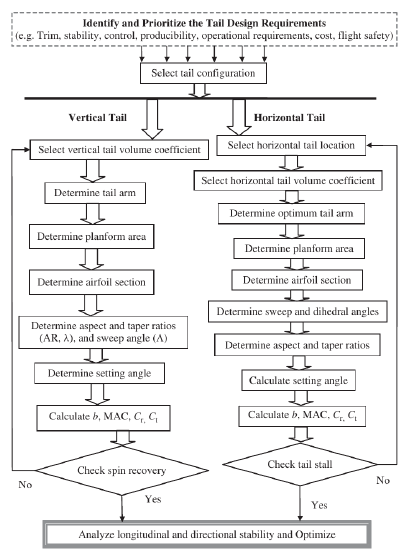
Trim is a condition in which summation of all the forces and moments acting on the aircraft is zero as well involves zero/minimum inputs from pilot/autopilot.
Longitudinal Trim
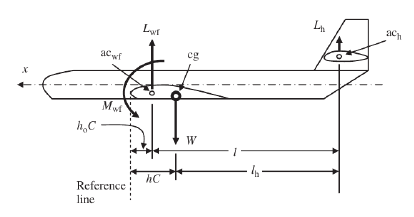
Summation of all moments is zero. \(\sum M_{cg} = 0\) \(M_{0,wf} + M_{L,wf} + M_{L,h} = 0\) \(\implies M_{o,wf} + L_{wf}(h-h_{0})\bar{C} - L_{h}\cdot l_{h}\)
$l_{h}$ is the moment arm length.
Non-dimensionalizing the above equation, we have
\(C_{m_{0},wf} + C_{L}(h-h_{0}) - \eta_{H}\bar{V}_{H} C_{L_{h}} = 0\) $\bar{V}{H}$ is an important non-dimensional parameter referred as horizontal tail volume coefficient. $\eta{H}$ is the tail efficiency and depends on the tail configuration.
\[\bar{V}_{H} = \frac{l S_{H}}{\bar{C} S}\]Directional and Lateral Trim
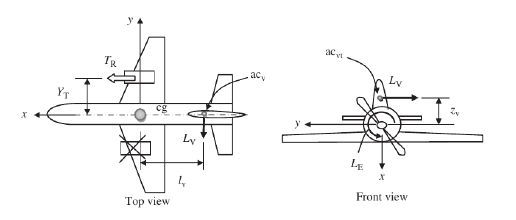
\(\sum N_{CG} = 0\,\, \implies T_{R}Y_{T} + L_{V}l_{vt} = 0\) \(\sum L_{CG} = 0\,\, \implies L_{E} + L_{V}z_{v} = 0\)
For static stability,
- $C_{m\alpha}$ < 0
- $C_{l\beta}$ < 0
- $C_{n\beta}$ > 0
For dynamic stability,
- Short period and phugoid modes should be damped.
- Dutch-roll, spiral and roll modes are damped => lateral directional stability.
Control
Ability of an aircraft to vary the aircraft condition from one trim condition to the other trim condition.
- Highly stable aircraft tends to be less controllable.
- Highly maneuverable aircraft tends to be less stable or even not stable.
- Handling qualities established as standards.
Design Parameters
Various parameters of design are determined and calculated to obtain a tail which satisfies the requirements.
- Tail Configuration
- Based on selection
- Comparing advantages and disadvantages of each configuration.
- Comprise has to be made.
- Canard or Aft tail
- Canards avoid deep stall and has higher efficiency than aft tail.
- Canards are longitudinally statically less stable.
- Canards can be used to generate lift as well as used for control.
- Optimum tail arm \(l_{opt} = K_{c}\sqrt{ \frac{4 \bar{C} S \bar{V}_{H}}{\pi D_{f}} }\)
- Horizontal tail volume coefficient
- Selected based on previous aircraft data.
- Tail lift coefficient
- Calculated from the longitudinal stability equation.
- Fixed, All-moving or Adjustable
- Fixed tail is much lighter, cheaper and structurally easier.
- All moving tail makes aircraft more maneuverable.
- All moving tail doesn’t have control surfaces.
- Most GA use a fixed tail, large transport aircraft utilize an adjustable tail.
- Most fighter aircraft employ an all-moving tail.
- Airfoil selection
- Able to generate the required lift at minimum drag.
- Must create positive and negative lift.
- Symmetric airfoil chosen
- Should never stall
- Must not have compressibility effects.
- Tail incidence
- Typical value would be about -1 deg.
- Dependent on the required lift and airfoil lift coefficient.
- For adjustable tail, max and min values should be determined.
- Aspect Ratio
- Elliptical lift distribution not required for tail.
- In a single engine prop driven aircraft, the AR should be larger than the tail span.
- Taper Ratio
- Influences stability, control, performance, aerodynamic efficiency, weight and CG.
- To reduce the tail weight.
- Sweep Angle
- Often same as the wing sweep angle.
- Tail Vertical Location
- Positioned such that the tail is out of the fuselage wake region.
- Vertical tail arm
- Often chosen the same as horizontal tail arm
- Vertical tail volume coefficient
- Chosen based on previous aircraft data.