Equations of Motion
Mechanics in Transition Orbit
Created on: 2024-12-01
Tags: #EOM
Course: AVD
Definition
The general equations of motion for a launch vehicle is derived in terms of the variables,
- Downrange ($x$): Range along the surface of Earth
- Altitude (h)
- Flight Path Angle ($\gamma$)
- Velocity of rocket ($v$)
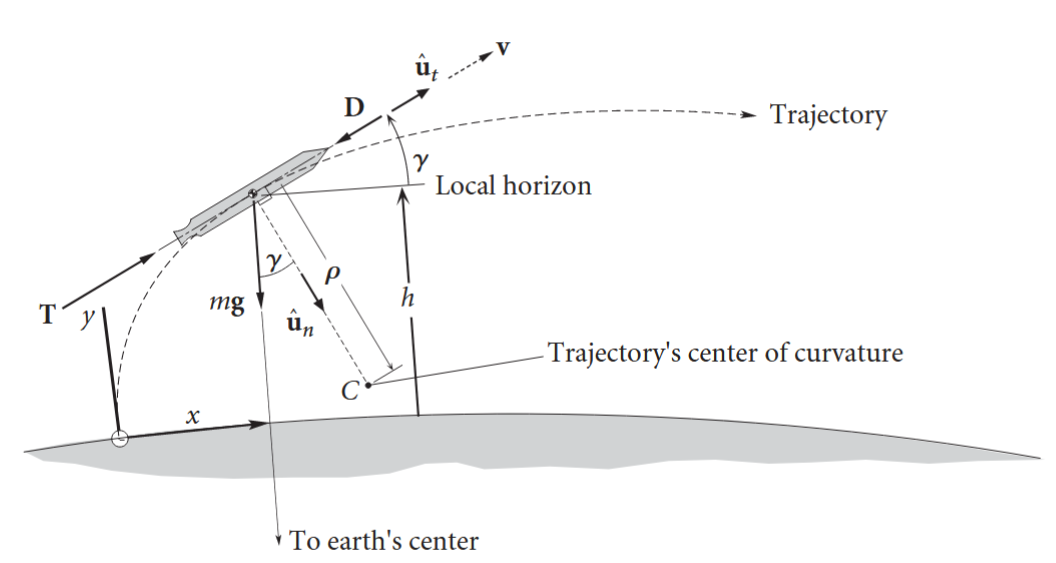
Balancing the forces in tangential and normal direction, we have
\[\begin{aligned} m\,a_{t} = T - D - mg\sin \gamma\\ m\,a_{n} = mg\cos \gamma \end{aligned}\]Now, $a_{t}$ and $a_{n}$ can be defined as, \(\begin{aligned} a_{t} = \frac{dv}{dt}\\ a_{n} = -v\frac{d\gamma}{dt} \end{aligned}\) To account for the Earth’s curvature, \(a_{n} = -v\frac{d\gamma}{dt} + \frac{v^2 \cos \gamma}{R_{E} + h}\)
Therefore by combining the equations we get,
\[\frac{dv}{dt} = \frac{T}{m} - \frac{D}{m} - g\sin \gamma\] \[v\frac{d\gamma}{dt} = -\left(g-\frac{v^2}{R_{E} + h}\right)\cos \gamma\] \[\frac{dh}{dt} = v\sin \gamma\] \[\frac{dx}{dt} = \frac{R_{e}\,V\cos \gamma}{R_{e} + h}\]The trajectory of any rocket can be simulated using the above equations.
Linked from
- No other published notes link here yet.