Elementary Viscous Flows
Created on: 2025-01-12
Tags: #PoiseuilleFlow #CouetteFlow
Course: Aerodynamics
Couette Flow
- Two-dimensional incompressible flow
- Flow between a fixed and a moving plate
- Viscous Flow
- Assumption: Plates are very wide and long.
- Only $u\ne0$ and $v=w=0$
- The upper plate moves with a velocity $V$ but no pressure gradient is present.
Continuity Equation
\(\frac{\partial u}{\partial x} = 0 \implies u = u(y)\) The velocity doesn’t vary with $x$ and is known as a fully-developed flow.
Momentum Equation
\(\rho\left( \frac{\partial u}{\partial x} + \frac{\partial v}{\partial y}\right) = - \frac{\partial p}{\partial x} + \mu \left(\frac{\partial^2 u}{\partial x^2} + \frac{\partial^2 u}{\partial y^2}\right)\) Substituting the values, we get \(\frac{\partial^2 u}{\partial y^2} = 0 \implies u = C_{1}y + C_{2}\)
Now, at $y=h$ \(u = V \implies C_{1}h + C_{2} = V\) And at $y=-h$ \(u=0 \implies -C_{1}h + C_{2} = 0\) Thus, \(u(y) = \frac{V}{2h}y + \frac{V}{2}\)
The flow has a linear velocity profile with no-slip at each wall.
Poiseuille Flow
- Both plates are fixed ($V=0$).
- The pressure varies in the $x$ direction.
- $u \ne 0$ and $v=w=0$, thus $u = u(y)$.
Using the $x$ momentum equation, we have \(\mu \frac{d^2 u}{d y^2} = \frac{d p}{d x} = const < 0\) Integrating, we get \(u = \frac{1}{\mu} \frac{dp}{dx} \frac{y^2}{2} + C_{1}y + C_{2}\) Now, at $y= \pm h$ the value of $u$ is 0. Thus, \(u = -\frac{dp}{dx} \frac{h^2}{2\mu}\left( 1-\frac{y^2}{h^2} \right)\)
Viscous Flow in Ducts
- Flow transitions from Laminar to Turbulent at approximately $\mathrm{Re}_{D} \approx 2300$ but can be delayed using smoothing.
Internal v/s External Flow
- An internal flow is constrained by the bounding walls.
- The viscous effects will meet and permeate the entire flow.
- The flow at inlet is nearly inviscid.
- The boundary layers grow downstream and meet at a point turning the whole flow as viscous.
- After a distance $L_{e}$, the flow is independent of $x$ and known as fully-developed flow. The distance $L_{e}$ is known as entrance length.
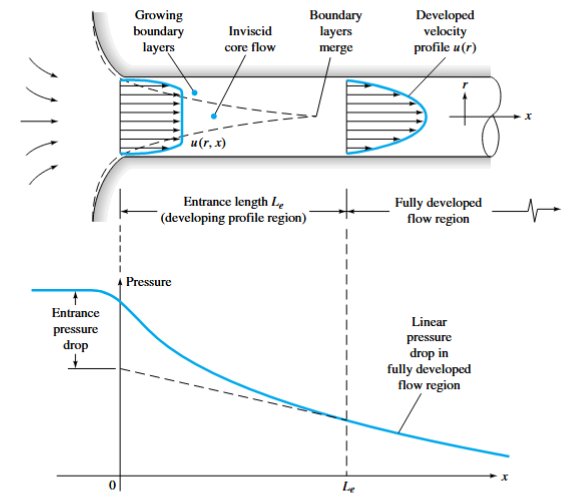
For laminar flow, $\frac{L_{e}}{d} \approx 0.06 \mathrm{Re}$. In turbulent flow, the boundary layers grow faster and hence the entrance length is small.
Flow in a circular pipe
- Steady flow.
- Fully developed.
- No shaft work or heat-transfer effects.
The friction head-loss $h_{f}$ is given as \(h_{f} = \Delta z + \frac{\Delta p}{\rho g}\) Now, the head-loss is equal to \(h_{f} = f \frac{L}{d} \frac{V^2}{2g}\) Here, $f$ is the Darcy friction factor which is a function of $\mathrm{Re}_{D}$ and $\varepsilon$ i.e. wall-roughness height.
The wall roughness height induces turbulence and hence effects the flow inside the pipe.
- Higher roughness –> Higher Friction factor and Quicker Turbulence achieved.
Moody Diagram is used to find out the value of $f$ for turbulent flows otherwise for laminar flow $f=\frac{64}{\mathrm{Re}}$.
Hydraulic Diameter ($D_{H}$) = $\frac{4A}{P}$ = $\frac{4\times\text{area}}{\text{wetted perimeter}}$
Linked from
- No other published notes link here yet.