Finite Wing
Created on: 2025-01-14
Tags: #FiniteWing #InducedDrag
Course: Aerodynamics
Downwash and Induced Drag
- Flow over an airfoil is two-dimensional whereas flow over a finite wing is three-dimensional.
- The existence of high-pressure on the bottom surface and low pressure on the top surface creates the lift.
- The imbalance causes the flow to curl from the high-pressure region below the tip to the low-pressure region on top.
- Thus, there is a flow component from tip toward the root. This bends the streamlines toward the root on top surface whereas towards the tip on bottom surface.
- This flow creates a circulatory motion that trails downstream of the wing. A trailing vortex is created at each wing tip.
- These wingtip vortices induces a small downward component of air velocity in the neighborhood of the wing itself.
- The downward component is called downwash.
-
It combines with the freestream velocity $V_{\infty}$ to produce a local relative wind.
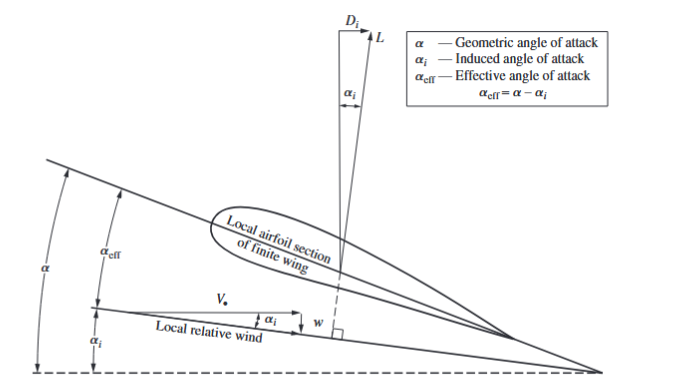
- The angle of attack seen by the airfoil is $\alpha_{eff}$ which is between the chord and local relative wind.
- $\alpha_{eff} = \alpha - \alpha_{i}$ where $\alpha$ is the geometric angle of attack and $\alpha_{i}$ is the induced angle of attack.
- $\alpha_{i} = w/V_{\infty}$ assuming $\alpha_{i}$ is small.
- The local lift vector is aligned perpendicular to the local relative wing and hence is inclined by the vertical by the angle of $\alpha_{i}$.
- There is component of local lift vector in the direction of $V_{\infty}$. This is a drag created by the presence of downwash and known as induced drag ($D_{i}$).
- Total Drag = Profile Drag + Induced Drag
- Profile Drag = Pressure Drag + Skin Friction Drag
The velocity induced at a given point P by an infinite straight vortex filament at at a perpendicular distance $h$ is \(V = \frac{\Gamma}{2\pi h}\)
For a semi-infinite vortex filament, \(V = \frac{\Gamma}{4\pi h}\)
Helmholtz’s Vortex Theorems
- The strength of a vortex filament is constant along its length.
- A vortex filament cannot end in a fluid. It must extend to the boundaries of the fluid or form a closed path.
Lift distribution along the span of a finite wing can be a function of spanwise distance owing to twist and flow over the wing.
Linked from
- No other published notes link here yet.