Turbofan
Created on: 2025-02-08
Tags: #Turbofan
Course: Airbreathing Propulsion
Definition
- A basic gas generator is followed by an additional turbine stage (s), which tap into the exhaust stream thermal energy to provide shaft power to a fan.
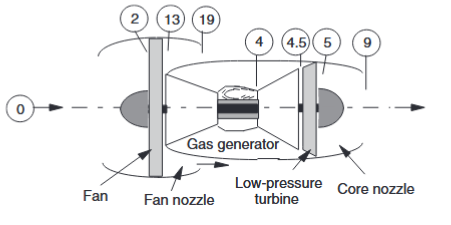
- The fan is a low-pressure compressor and driven by a low-pressure turbine.
- The bypass ratio is defined as the flow rate in the fan bypass duct to that of the gas generator. \(\alpha = \frac{\dot{m}_{bypass}}{\dot{m}_{core}}\)
- The fan pressure ratio is given as \(\pi_{f} = \frac{P_{t13}}{P_{t2}}\)
- The fan exhaust stream may be separate from the so-called core stream and hence referred to as separate exhaust turbofan engine.
- It is possible to extend the fan duct and provide mixing of the fan and the core stream in a common exhaust nozzle.
-
The adiabatic efficiency of the fan is defined as \(\eta_{f} = \frac{\Delta h_{t,isentropic}}{\Delta h_{t,actual}} = \frac{\pi_{f}^{(\gamma-1)/\gamma}-1}{\tau_{f}-1}\)
-
The power balance between the turbine and compressor now includes the fan, and written as \(\eta_{m}(\dot{m}_{0}+\dot{m}_{f})(h_{t4}-h_{t5}) = \dot{m}_{0}(h_{t3}-h_{t2}) + \alpha \dot{m}_{0}(h_{t13}-h_{t2})\)
- The engine consists of two nozzles i.e. one for the fan flow and core flow. The total thrust is the sum of gross thrust achieved using both the nozzles.
Linked from
- No other published notes link here yet.