Origin of Earth
Created on: 2024-12-12
Tags: #originofEarth
Course: Astrobiology
- Accretion: Planetesimals collided and merged to form protoplanets.
- Differentiation: Earth cooled and distinct layers within the earth were formed.
- Formation of Moon: A large body collied with the early earth separate a part of earth and moon was formed.
- Development of Atmosphere:
- The early atmosphere was primarily composed of volcanic gases, including water vapor, carbon dioxide, nitrogen, and sulfur compounds.
- As Earth cooled, water vapor condensed to form oceans, leading to significant changes in atmospheric composition.
- Emergence of Life:
- The earliest life forms, likely simple prokaryotic organisms, emerged around ~3.5 billion years ago in the oceans.
- These organisms played a crucial role in altering the atmosphere, particularly through the process of photosynthesis, which introduced oxygen.
- Geological Activity: Earth has undergone continuous geological processes, such as plate tectonics, volcanism, and erosion, shaping its surface and influencing the evolution of life
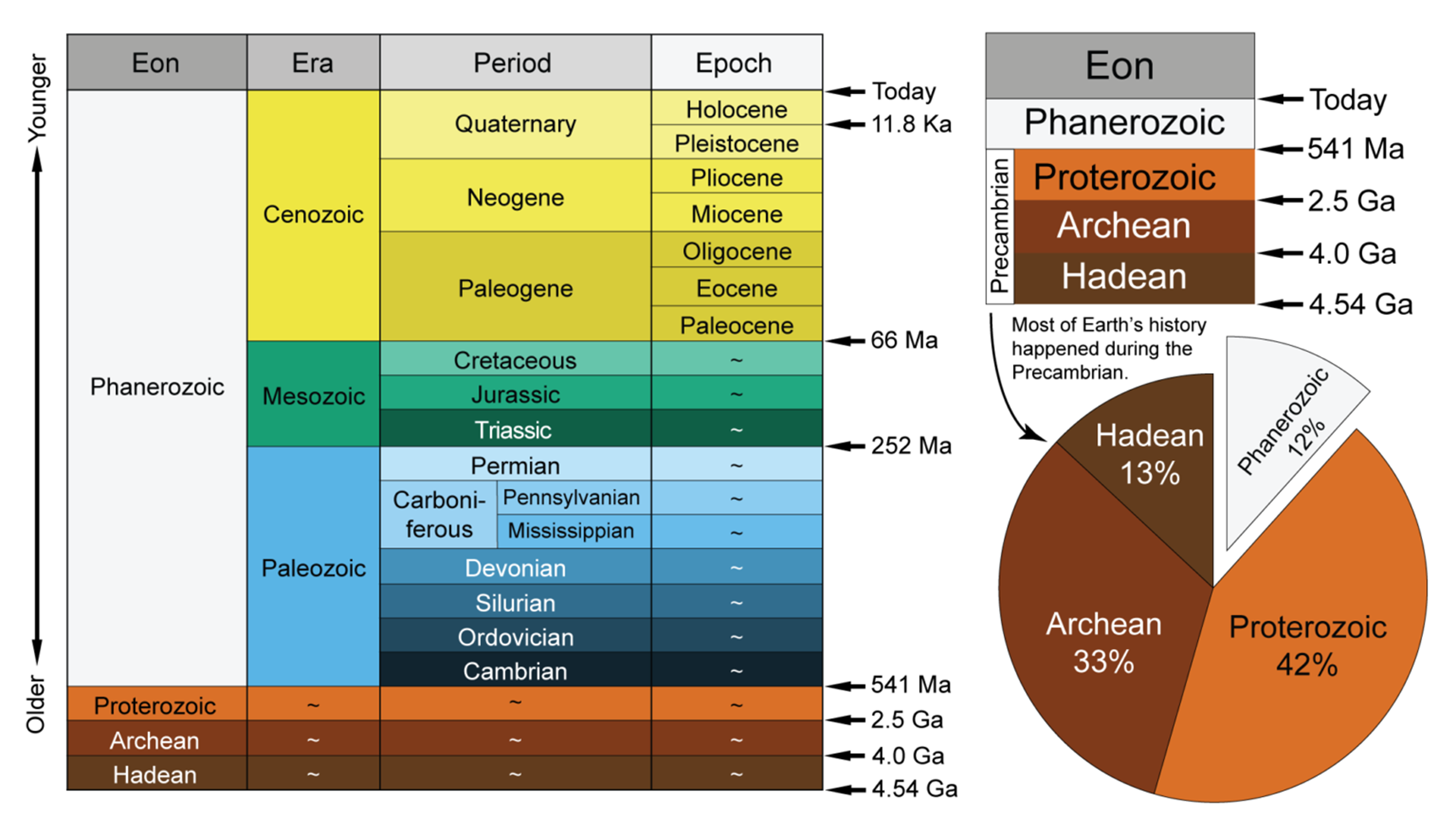
Geological Time Scale is a system to describe the timing and relationships in Earth’s history.
Evolution of Atmosphere
Primary Atmosphere
- Volcanic Outgassing releases water vapor, carbon dioxide, carbon monoxide, methane, nitrogen, ammonia, and sulphur gases.
- Nitrogen built up in the atmosphere.
- Water vapor condensed to form the oceans as the Earth cooled.
- No oxygen in this phase.
- Rich in carbon dioxide.
Secondary Atmosphere
- Chemically active volatiles: H, C, N, O, S
- Primordial noble gases were present.
- Element that form non-volatile minerals: Mg, S, Fe.
Present Atmosphere
- Life in ocean started consuming the carbon dioxide and releasing oxygen in large amount for photosynthesis.
- Photochemical dissociation due to radiation broke water vapor into hydrogen and oxygen molecules.
- Great oxidation event took place.
- Carbon dioxide was locked in sedimentary rocks, fossil fuels and dissolved in oceans.
Formation of Oceans
- Much water is from volcanic degassing
- Salts in ocean is derived from weathering and carried to the oceans by rivers.
- Part of the earth’s water probably came from comets.
Phosphorus
- All living organism require phosphorus for synthesis of nucleic acids, phospholipids, ATP, etc.
- Essential in prebiotic chemistry.
- Weathering of phosphate minerals was an important source.
- Phosphorus minerals accumulated in Earth’s crust due to tectonic and volcanic activites,
Linked from
- No other published notes link here yet.