Prokaryotes and Eukaryotes
Created on: 2024-12-05
Tags: #prokaryotes #eukaryotes
Course: Astrobiology
Definition
Prokaryote is a single-celled organism whose cell lacks nuclear membrane and other membrane bound organelles.
Eukaryote is a group of organisms whose cell have membrane bound nucleus and other organelles. They can be unicellular and multicellular.

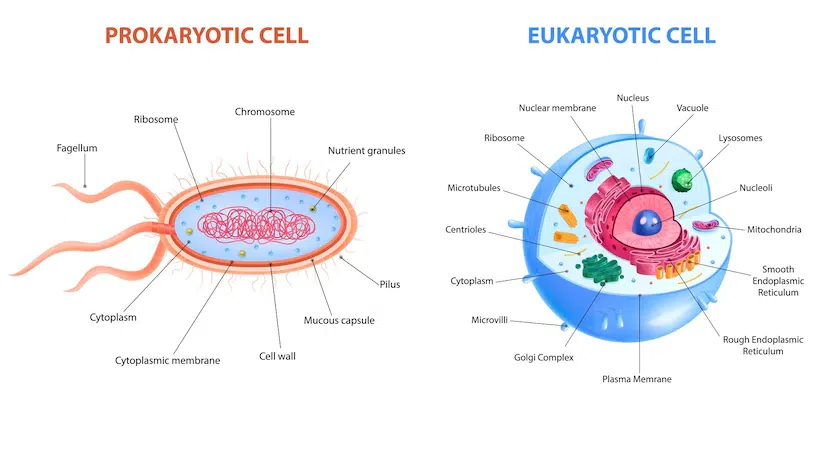
Similarities
- Genetic material for both is DNA.
- Existence of ribosome in both, which produces proteins.
- Existence of cell membrane in both.
- Cytoplasm exists in both.
- Cell wall is present in both.
Differences
| Prokaryotes | Eukaryotes |
|---|---|
| No proper nucleus. | A proper membrane bounded nucleus. |
| Genetic material is present in cytoplasm. | Genetic material is present inside nucleus. |
| No specific organelles. | Membrane bounded organelles. |
Linked from
- No other published notes link here yet.