Extremas
Maxima and Minima
Created on: 2024-12-23
Tags: #Maxima #Minima
Course: Calculus
Definition
A function has an absolute maximum value on $D$ at a point $c$ if \(f(x) \leq f(c)\,\,\, \text{for all x in D}\) And an absolute minima value of $D$ at c if \(f(x) \geq f(c)\,\,\, \text{for all x in D}\)
The maxima and minima are collectively known as extrema. Absolute extrema are also called global extrema.
Local extrema is a maxima and minima in some open interval containing that point.
Critical Point: An interior point of the domain of a function $f$ where $f\,’$ is zero or undefined.
Extreme Value Theorem
If $f$ is continuous on a closed interval $[a,b]$, then $f$ attains both an absolute maxima and minima in $[a,b]$.
First Derivative Test
Monotonic functions: Functions which either increase or decrease throughout the domain is known as a monotonic function.
If $x_{1}$ and $x_{2}$ are any two points in the domain, \(\begin{gathered} f(x_{1}) < f(x_{2})\,\,\text{whenever}\,\, x_{1}<x_{2}\implies \text{Increasing}\\ f(x_{1}) > f(x_{2})\,\,\text{whenever}\,\, x_{1}<x_{2}\implies \text{Decreasing}\\ \end{gathered}\) If $f\,’(x)>0$ at each point $x \in(a,b)$, then $f$ is monotonically increasing, otherwise if $f\,’(x)<0$, then $f$ is monotonically decreasing.
- If $f\,’$ changes from negative to positive at $c$, then $f$ has a local minimum at $c$.
- If $f\,’$ changes from positive to negative at $c$, then $f$ has a local maximum at $c$.
Second Derivative Test
Suppose $f’’$ is continuous on an open interval that contains $x=c$,
- If $f’(c)= 0$ and $f’‘(c)>0$, the function has a local minima at c.
- If $f’(c)= 0$ and $f’‘(c)<0$, the function has a local maxima at c.
- If $f’(c)= 0$ and $f’‘(c)=0$, the test fails.
The extreme values of $f(x,y)$ can occur only at
- Boundary points of the domain of f.
- Critical points i.e. where $f_{x}=f_{y}=0$.
Second derivative test for $f(x,y)$
- $f_{x x}<0$ and $f_{x x}f_{y y} - f_{xy}^2 >0$ at $(a, b) \implies$ Local Minima
- $f_{x x}>0$ and $f_{x x}f_{y y} - f_{xy}^2 >0$ at $(a, b) \implies$ Local Maxima
- $f_{x x}f_{y y} - f_{xy}^2 <0$ at $(a, b) \implies$ Saddle Point
- $f_{x x}f_{y y} - f_{xy}^2 =0$ at $(a, b) \implies$ Test is inconclusive
Concavity
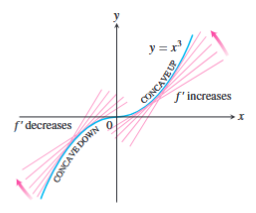
The graph of a differentiable function $y=f(x)$ is
- concave up on an open interval if $f\,’$ is increasing, i.e. $f’‘>0$.
- concave down on an open interval if $f\,’$ is decreasing, i.e. $f’‘<0$.
A point where the graph of a function has a tangent line and where the concavity changes is a point of inflection.
Linked from
- No other published notes link here yet.