2-DOF Systems
Created on: 2025-02-03
Tags: #2-DOFSystems
Course: Dynamics
Definition
- Degree of Freedom = Number of Mass x Number of independent directions of movement.
- A simple 2-DOF system is composed of two masses connected through springs with the wall and between themselves.
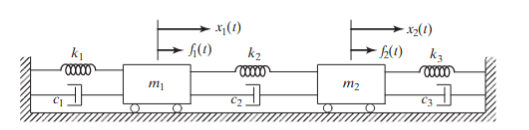
- For positive $x_{1}$ and $x_{2}$, spring 1, damper 1, spring 2 and damper 2 are in tension.
- Whereas spring 3 and damper 3 are in compression.
- The equation of motion for the system is given as \(\begin{gathered} m_{1}\ddot{x_{1}} = - c_{1}\dot{x_{1}} + c_{2}(\dot{x_{2}}- \dot{x_{1}}) -k_{1}x_{1} + k_{2}(x_{2}-x_{1}) + f_{1}\\ m_{2}\ddot{x_{2}} = - c_{2}(\dot{x_{2}}-\dot{x_{1}}) - c_{3}\dot{x_{2}} - k_{2}(x_{2}-x_{1}) -k_{3}x_{2} + f_{2}\\ \end{gathered}\)
- The EOM can be rearranged as the following \(\begin{gathered} m_{1}\ddot{x_{1}} + (c_{1}+c_{2})\dot{x_{1}} - c_{2}\dot{x_{2}} +(k_{1}+k_{2})x_{1} - k_{2}x_{2} = f_{1}\\ m_{2}\ddot{x_{2}} + (c_{2}+c_{3})\dot{x_{2}} -c_{2}\dot{x_{1}} + (k_{2}+k_{3})x_{2}-k_{2}x_{1} = f_{2}\\ \end{gathered}\)
- The system can be written as matrix equation.
\([m] = \begin{bmatrix} m_{1} & 0 \\ 0 & m_{2} \end{bmatrix}\) \([c] = \begin{bmatrix} c_{1}+c_{2} & -c_{2} \\ -c_{2} & c_{2}+c_{3} \end{bmatrix}\) \([k] = \begin{bmatrix} k_{1}+k_{2} & -k_{2} \\ -k_{2} & k_{2}+k_{3} \end{bmatrix}\) \([m]\,\ddot{\vec{x}}(t) + [c]\,\dot{\vec{x}}(t) + [k]\,\vec{x}(t) = \vec{f}(t)\)
Free vibration of an undamped system
- The governing system of differential equation becomes \([m]\,\ddot{\vec{x}}(t) + [k]\,\vec{x}(t) = 0\)
-
We are interested in understanding the motion of the blocks with same frequency and phase angle but with different amplitudes. Hence, the solution is taken as \(\begin{gathered} x_{1}(t) = X_{1} \cos(\omega t+\phi)\\ x_{2}(t) = X_{2} \cos(\omega t+\phi) \end{gathered}\)
- Substituting the solution and finding the determinant of the resultant matrix, we get the frequency or characteristic equation.
- The solution of the equation yields two frequencies which are the natural frequencies of the system.
- Putting the value of $\omega = \omega_{1}$ and $\omega=\omega_{2}$, we get the first and second mode of the system.
Linked from
- No other published notes link here yet.