Natural Coordinates
Created on: 2024-12-03
Tags: #naturalCoordinates
Course: FEM
Definition
Alternate method to find the shape functions of an element.
- Parent rectangular element in natural coordinates $(\xi,\eta)$ transformed to the child element in the real $(x,y)$ coordinates.
- Natural coordinates vary from -1 to 1.
- Size of the parent element is $2\times2$ irrespective of the actual element size in real Cartesian coordinates.
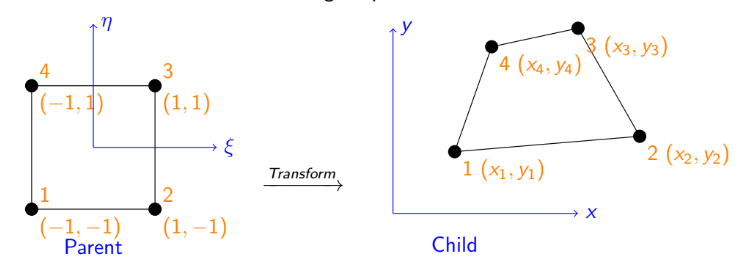
Coordinate Transformation Interpolation of coordinates of a point within the element from nodal points. Shape function denoted as $N_{c}$.
Variable Interpolation Interpolation of the unknown field variable. Shape function denoted as $N_{v}$
Based on the these two interpolations, elements are classified as
- Isoparametric elements: $N_{c} = N_{v}$
- Sub-parametric elements: $N_{c} < N_{v}$
- Super-parametric elements: $N_{c} > N_{v}$
Transformation from natural to real coordinates
\(x(\xi, \eta) = \sum N_{i}\,x_{i}\) \(y(\xi,\eta) = \sum N_{i}\,y_{i}\)