Linux Kernel
Created on: 2025-01-22
Tags: #Linux #Kernel
Course: HPC
Kernel
- The kernel provides a platform for programs and various services to run on top of it.
- It is responsible for managing system resources, handling hardware communication and ensuring smooth execution of processes.
- Linux Kernel follows a monolithic architecture i.e. it runs as a single large process in a privileged mode which the hardware sees.
- For the other applications/codes, it creates virtual machines and manages them.
- It supports Loadable Kernel Machines (LKMs), allowing dynamic addition or removal of features which allows various flavors of Linux.
Kernel It virtualizes the computer’s common hardware resources to provide each process with its own virtual resources.
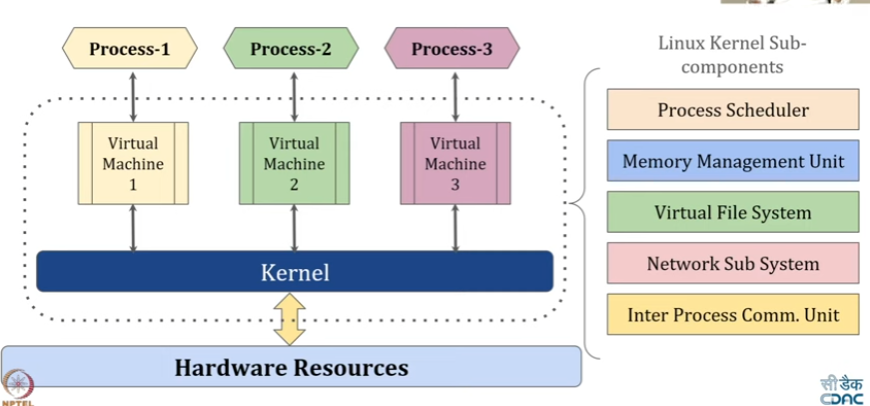
Process Scheduler
- Responsible for managing how processes are allocated to the CPU.
- Maximize CPU utilization and ensure smooth multitasking by determining which processes get CPU time and for how long.
- Scheduling Policy
- Process States
- Preemptive v/s Non-preemptive scheduling
- Context Switching
- Load Balancing
Memory Management Unit
- It is responsible for efficiently managing both physical and virtual memory.
- Address Translation (Virtual to Physical mapping)
- Page Table: to store the mapping between virtual addresses and physical addresses.
- TLB (Translation Lookaside Buffer): a small, fast cache to store recent data
- Memory protection, Cache Control, etc.
Virtual File System
- It is an abstraction layer that allows the Linux kernel to interface with different file systems in a uniform way.
- Superblock: Represents an entire mounted file system.
- Inode: Stores metadata about individual files or directories.
- Dentry: Represents directory entries
- Mount Points: Where file systems are mounted.
- File system operations, types.
Network Sub-System
- It manages communication between devices over a network.
- It is responsible for processing, routing, and managing all network packets as they pass through the system.
- Socket API: Interface between user-space applications and the kernel.
- Protocol
- Network stack, network devices.
- Packet Processing.
Inter Process Communication (IPC) Unit
- It allows processes to communicate and synchronize their actions with each other.
- This communication is essential for tasks that require collaboration between multiple processes or need shared access to system resources.
- Message Queues - allow processes to exchange messages.
- Shared memory - allows multiple processes to access the same memory region.
- Semaphores (Synchronization Primitives), Signals (Asynchronous notifications), etc.
Linux Library Files
- In the linux mostly everything is a file.
- The abstraction simplifies interaction with various components of the system.
- System libraries are essential components that provide commonly used functions and services to program.
- System libraries are shared by multiple applications, making them highly efficient in terms of memory usage and execution speed.
- Regular files: text files, binary files, scripts.
- Directories: File that contain information about other files.
- Devices: Devices are represented as files in the /dev directory.
- Symbolic link: A file that points to another file or directory.
- Network Interfaces: Treated like files within Linux.
Linked from
- No other published notes link here yet.