Memory Systems
Created on: 2025-02-04
Tags: #MemorySystems
Course: HPC
Definition
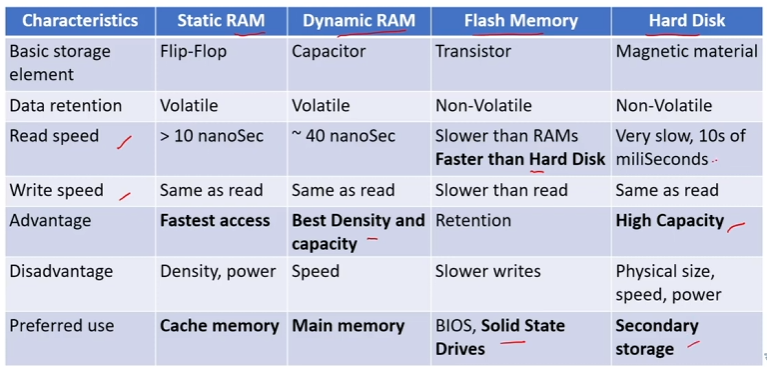
- Types
- Static RAM
- Dynamic RAM
- Flash Memory
- Hard Disk
How CPU access memory ?
- Read: A load instruction is decoded. The operand is address.
- CPU puts the address on the Address Bus.
- Memory responds with data from the specified address and put on the Data Bus.
- CPU accepts the data.
- Write: Store instruction specifies address and data.
- CPU address and data on bus.
- Memory stores the data at specified address location.
Memory Requirements
- Programmers want unlimited amount of fast memory.
- Realities
- Fast memory is costly (SRAM).
- Programs tend to follow principle of locality.
- Temporal: Same location is repeatedly accessed.
- Spatial: Close by locations are accessed soon.
- Hardware aids programmer by creating an illusion of unlimited fast memory.
- Memory are not able to keep up with the achieved by microprocessors.
- Interleaving the memory
- Odd address in one bank and even address in another bank.
- Results in overlapping memory delays and speedup the operations.
- Wider memory paths
- More data is fetched per access cycle.
- Cache memory system
- Faster memory to serve frequently used data and code.
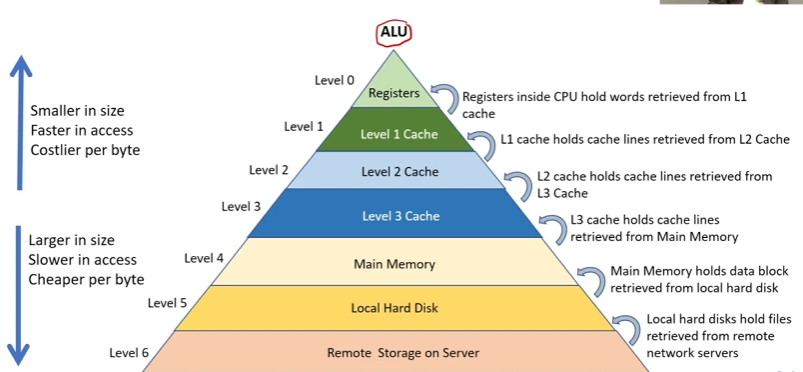
Memory Hierarchy
- Takes advantage of principle of locality.
- Memory subsystem consists of multiple levels with different speeds and sizes.
- Small fast memory is put close to processor and slower away.
- Maximum memory which is cheapest.
- Access at the speed offered by the fastest.
- Data is copied only between two adjacent levels.
- If data is found in level closest to CPU, it’s a hit.
- Hit rate is a measure of the performance.
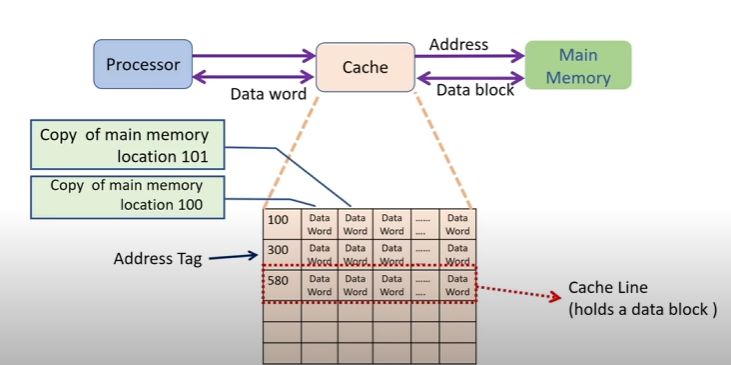
Cache
- A safe place for hiding or storing things
- Contains a copy of portions of main memory
- Acts as a buffer between CPU and main memory.
- Cache memories work on the phenomenon of locality of reference.
- If a memory location is referenced by the processor, then it is very likely that the same memory location as well the nearby address blocks are to be accessed by the CPU.
- It consists of 3 main parts
- Directory Store: Information about the origin about data.
- Data Section
- Status Information
- Cache controller is a hardware that copies information from main memory to cache memory automatically.
- Mapping scheme helps in replacing old data with new data.
- Cache efficiency is measured through hit rate.
MIMD Systems
- Shared Memory
- Symmetric Multiprocessing (SMP): All the processors share the same memory and I/O facilities including access time.
- Non-Uniform Memory Access: All processors have access to all parts of main memory but the access time differs.
- There is a practical limit on the number of processors and memory which could be used in SMP.
- Distributed Memory
- Cluster: A group of interconnected, standalone commodity computers that work together as a unified computer resource.
- Extreme scalability.
- Incremental scalability
- Availability
- Superior price/performance.
- Dependent on Bandwidth and Latency.
Linked from
- No other published notes link here yet.