OpenMP Programming
Created on: 2025-02-16
Tags: #OpenMP #Programming
Course: HPC
Definition
- Shared Memory Programming using OpenMP
- OpenMP: An API for writing parallel applications.
- Greatly simplifies writing multithreaded programs in Fortran, C, and C++.
OpenMP Common Cores
Most OpenMP programs only use these 21 items 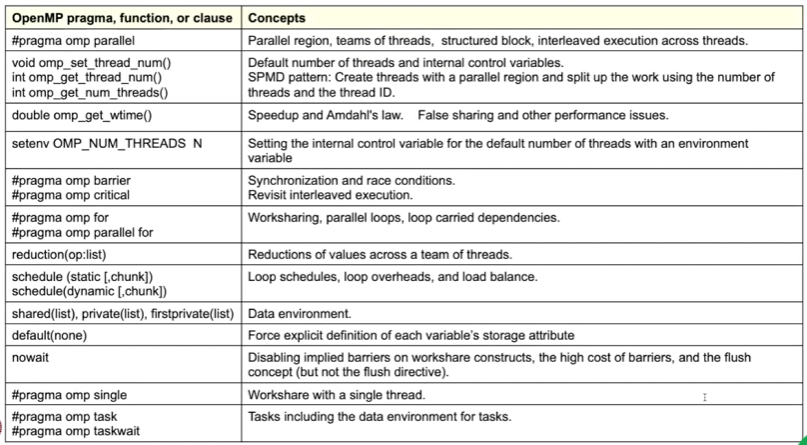
OpenMP Basic Definitions
- We focus on Symmetric Multiprocessor Case i.e. lots of threads with “equal cost access” to memory.
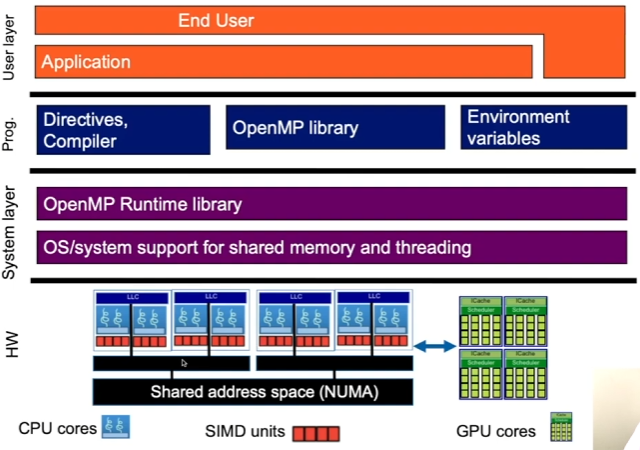
OpenMP Basic Syntax
- Most of OpenMP happens through compiler directives.
- Compiler Directives:
- C and C++:
#pragma omp construct [clause [clause]] - Fortran:
!$OMP construct [clause [clause]]
- C and C++:
- Example ```C #pragma omp parallel private(x) {
}
1
2
3
4
5

```Fortran
!$OMP PARALLEL PRIVATE(X)

!$OMP END PARALLEL
- Function Prototypes and types:
-
#include <omp.h>oruse OMP_LIB
-
- Most OpenMP constructs apply to a “structured block”.
Exercise, Part A: Hello World
- Serial Version ```C++ #include
int main() { printf(“Hello”); printf(“world\n”); }
1
2
3
4
5
6
7
8
9
10
11
12
13
 - Parallel Version
```C++
#include <omp.h>
#include <stdio.h>

int main()
{
 #pragma omp parallel
 {
 printf("hello");
 printf("world\n");
 }
}
- The statements are interleaved based on how the operating schedules the threads.
- The misprint in the output is due to lack of synchronization.
Terminology in Parallel Computation
- Task: A sequence of instructions plus a data environment. A program is composed of one or more tasks.
- Active Task: A task that is available to be scheduled for execution. When the task is moving through its sequence of instructions.
- Fair Scheduling: When a scheduler gives each active task an equal opportunity for execution.
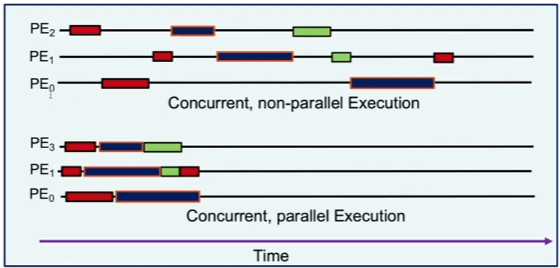
- Concurrency: A condition of a system in which multiple tasks are active and unordered.
- If scheduled fairly, they can be described as logically making forward progress at the same time.
- Parallelism: A condition of a system in which multiple tasks are actually making forward progress at the same time.
Execution Model
- Fork-Join Parallelism
- Initial thread spawns a team of threads as needed.
- Parallelism added incrementally until performance goals are met i.e. the sequential program evolves into a parallel program.
- The compiler directive forks and creates multiple threads.
- Number of threads handled through the environment variable
OMP_NUM_THREADS. It can be less than or more than number of processors. - The number of threads can be set inside the code using
omp_set_num_threads(n). The thread id is returned byomp_get_thread_num()function.
#include <omp.h>
#include <stdio.h>

int main()
{
 omp_set_num_threads(4)
 #pragma omp parallel
 {
 int ID = omp_get_thread_num()
 printf("hello world %d \n", ID);
 }
}
- The above program outputs using one thread at a time but the order of execution of thread is not same always.
- Each thread executes the same code redundantly.
- Once a team of threads has launched, it will not be reduced.
-
omp_get_num_threadswill return the actual number of threads in the team.
Approximation of Pi
- Mathematically, we know \(\int_{0}^1 \frac{4}{1+x^2}dx = \pi\)
-
Approximation using numerical integration \(\Delta x \sum_{i=0}^N f(x_{i}) \approx \pi\)
- Serial program in C++
#include <omp.h> static long num_step = 1E5; double step; int main() { double x, pi, sum=0.0; step = 1.0/(double) num_steps; double tdata = omp_get_wtime(); for (int i=0;i<num_steps;i++){ x = (i+0.5)*step; sum = sum + 4.0/(1.0+x*x); } pi = step * sum; tdata = omp_get_wtime()-tdata; prinf("pi = %f in %f secs\n",pi,tdata); } - A simple SingleProgramMultipleData in C++
#include <omp.h> static long num_step = 1E5; double step; #define NUM_THREADS 2 void main() { int i, nthreads; double pi, sum[NUM_THREADS]; step = 1.0/(double) num_steps; omp_set_num_threads(NUM_THREADS); tdata = omp_get_wtime() #pragma omp parallel { int i, id, numthrds; double x; id = omp_get_thread_num(); numthrds = omp_get_num_threads(); if(id==0) nthreads = numthrds; for (i=id,sum[id]=0.0;i<num_steps;i+numthrds){ x = (i+0.5)*step; sum = sum + 4.0/(1.0+x*x); } } for(i=0, pi=0.0;i<nthreads;i++){ pi += step * sum[i]; } tdata = omp_get_wtime()-tdata; prinf("pi = %f in %f secs\n",pi,tdata); } - Promote scalar to an array dimensioned by number of threads to avoid race condition.
- A block distribution can be used i.e. divide the domain into blocks and each block is computed by each thread.
- It is advised to run a program about 5 times and take the average computation time.
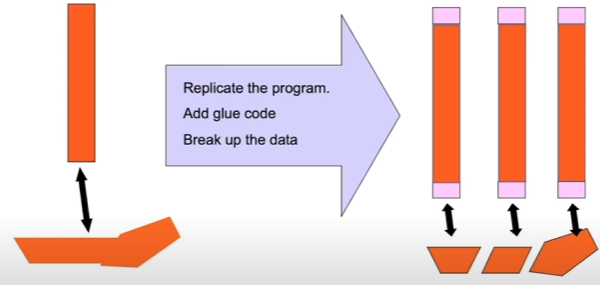
- MPI programs almost always use this pattern. It is probably the most commonly used pattern in the history of parallel programming.
Performance issues related to parallel programs.
- Ideally runtime is cut by ~1/P by parallel programs.
- Speedup: the increased performance from running on P processors. \(S(P) = \frac{Time_{seq}(1)}{Time_{par}(P)}\)
- Perfect Linear Speedup: Happens when no parallel overhead and algorithm is 100% parallel. \(S(P) = P\)
- Super-linear Speedup: Typically due to cache effects i.e. as P grows, aggregate cache size grows so more of the problem fits in cache. \(S(P)>P\)
- The maximum possible speedup is: \(S = \frac{1}{\alpha}\)
- Where $\alpha$ is the fraction of code which is serial.
- With increase in processors, the number of serial management of the threads.
-
We should always pick the optimum number of threads required for the problem.
- The poor scaling of SIMD code is due to False Sharing due to
sum[i]. The variable is sloshed back and forth between threads. - Eliminate false sharing by padding the sum array.
1
2
 #define PAD 8 // assume 64 byte L1 cache line size.
sum[NUM_THREADS][PAD];
- It is utilizing higher memory which is a disadvantage.
- The sum of each thread is stored in a different cache line.
Synchronization
- High level synchronization included in the common core:
- CRITICAL
- BARRIER
Critical Region
- Mutual Exclusion: Only one thread at a time can enter a critical region
- Threads wait their turn.
1
 #pragama omp critical
Barrier Region
- A point in a program all threads must reach before any threads are allowed to proceed.
- Threads wait until all threads hit the barrier. Then they can go on.
1
 #pragma omp barrier
Modified Pi Computation code
#include <omp.h>
static long num_step = 1E5;
double step;
#define NUM_THREADS 2
void main()
{
 int i, nthreads;
 double pi=0.0;
 step = 1.0/(double) num_steps;
 omp_set_num_threads(NUM_THREADS);
 tdata = omp_get_wtime()
 #pragma omp parallel
 {
 	int i, id, numthrds;
 	double x, sum;
 	id = omp_get_thread_num();
 	numthrds = omp_get_num_threads();
 	if(id==0) nthreads = numthrds;
 	for (i=id,sum=0.0;i<num_steps;i+numthrds){
	 	x = (i+0.5)*step;
	 	sum += + 4.0/(1.0+x*x);
 	}
 	#pragma omp critical
 	pi += step * sum;
 }
 tdata = omp_get_wtime()-tdata;
 prinf("pi = %f in %f secs\n",pi,tdata);
}
- It has a scalar local variable sum for each thread to accumulate the partial sums.
- No array, so no false sharing.
- The sum variable goes ‘out of scope’ beyond the parallel region so we must sum it inside the parallel program using critical synchronization.
Parallel Loops
Loop Worksharing Construct
- The loop worksharing construct splits up loop iterations among the threads in a team.
1 2 3 4 5 6 7
#pragma omp parallel { #pragma omp for for (I=0;I<N;I++){ NEAT_STUFF(I); } } - The loop control index I is made “private” to each thread by default.
- It will select the number of threads and divide the loop equally over the threads automatically.
- The workload may not be equal in each case. In that case Dynamic Scheduling can be used but it is high unpredictable and non-uniform.
- Static scheduling is pre-determined and predictable by the programmer.
Reduction
- Combination of values into a single accumulation variable.
- There is a true dependence between loop iterations that can’t be trivially removed.
- This is a very common situation called “Reduction”.
- Support for reduction operations is included in most parallel programming environments.
double ave=0.0, A[MAX];
int i;
for (i=0;i<MAX;i++){
	ave+= A[i];
}
ave = ave/MAX
- OpenMP reduction clause:
reduction (op:list) - The variables in list must be shared in the enclosing parallel region.
double ave=0.0, A[MAX]; int i; #pragma omp parallel for reduction (+:ave) for (i=0;i<MAX;i++){ ave+= A[i]; } ave = ave/MAX - Inside a parallel or a work-sharing construct:
- A local copy of each list variable is made and initialized depending on the operation.
- Updates occur on the local copy.
- Local copies are reduced into a single value and combined with the original global value.
// PI with a loop and a reduction
#include <omp.h>
static long num_steps = 100000;
double step;
void main()
{
	double pi,sum=0.0;
	step = 1.0/(double) num_steps;
	#pragma omp parallel for reduction(+:sum)
	for (int i=0;i<num_steps;i++){
		x = (i+0.5)*step;
		sum = sum + 4.0/(1.0+x*x);
	}
	pi = step*sum;
}
The nowait clause
- Critical and Barriers are really expensive. You need to understand when they are implied and how to skip them when it’s safe to do so.
- There is an implicit barrier at the end of a for worksharing construct. This can be removed/prevented by using
#pragma omp for nowait.
Linked from
- No other published notes link here yet.