System of Equations
Created on: 2024-12-20
Tags: #SytemofEquations
Course: Linear Algebra
Definition
A linear system of $m$ equations in $n$ unknowns $x_{1},x_{2},x_{3},\dots,x_{n}$ is a set of equations of the form \(\begin{gathered} a_{11}x_{1} + \dots + a_{1n}x_{n} = b_{1}\\ a_{21}x_{1} + \dots + a_{2n}x_{n} = b_{2}\\ \dots\\ a_{m1}x_{1} + \dots + a_{mn}x_{n} = b_{m}\\ \end{gathered}\)
The system is called homogenous if the value of $b_{j}$ is zero otherwise it is known as non-homogenous.
A solution of the linear system is a set of number $x_{1},x_{2},x_{3},\dots,x_{n}$ that satisfies all the $m$ equations.
Matrix form
The system can be represented using a single vector equation \(Ax = b\) Here,
- $A$ is the coefficient matrix of size $m\times n$.
- $x$ is the solution vector of size $n\times 1$.
- $b$ is the RHS vector of size $m\times1$
Types of System
- Determined: If the number of equations and the number of variables are equal.
- Underdetermined: If the number of equations is less than the number of variables.
- Overdetermined: If the number of equations is more than the number of variables.
- Consistent: If the system has at least one solution.
- Inconsistent: If the system has no solution.
Gauss Elimination
Row operations are used to obtain a triangular system and back substitution is used to obtain the solution.
Row echelon form: The coefficient matrix at the end of the Gauss elimination.
- If rows of zero are present, are the last rows.
- In each non-zero row, the leftmost non-zero entry is farther to the right than in the previous row.
Example, \(\begin{bmatrix} 3 &2 &1 \\ 0 &1 &4 \\ 0 &0 &0 \end{bmatrix}\)
Row operations
- Interchange of two rows
- Addition of a constant multiple of one row to another row
- Multiplication of a row by a non-zero constant.
Possible Cases of Solution
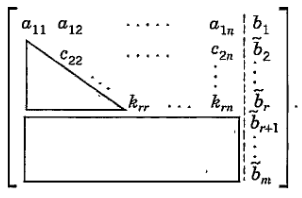
- Exactly one solution: If $r=n$ and $\bar{b}{r+1}, \dots,\bar{b}{m}$, if present are zero.
- Infinitely many solution: If $r<n$ and $\bar{b}{r+1}, \dots,\bar{b}{m}$, if present are zero.
- No Solution: If $r<n$ and one of the entries $\bar{b}{r+1}, \dots,\bar{b}{m}$, is not zero.
Cramer’s Rule
The solution of a system of linear equations can be found using Cramer’s rule. It states that
\(x_{k} = \frac{D_{k}}{D}\) Where,
- D is the determinant of the coefficient matrix.
- $D_{k}$ is the determinant matrix but the $k^{th}$ column is replaced with the RHS vector. \(D_{k} = \begin{vmatrix} a_{11} & a_{12} & \dots & b_{1} & \dots & a_{1n}\\ a_{21} & a_{22} & \dots & b_{2} & \dots & a_{2n}\\ . & . & \dots & . & \dots & .\\ a_{n1} & a_{n2} & \dots & b_{n} & \dots & a_{nn}\\ \end{vmatrix}\)
For a homogenous system, if $D=0$, then the system has non-trivial solutions.
Linked from
- No other published notes link here yet.