Failure Theories
Created on: 2025-01-30
Tags: #FailureTheories
Course: MOS
Maximum Shear-Stress Theory/Tresca Yield
- The theory results from the observation that in a ductile materials slip occurs during yielding along the critically oriented planes.
- Whenever a certain critical value $\tau_{cr}$ is reached yielding in an element commences. Thus,
\(\tau_{max} \le \frac{\sigma_{yp}}{2}\)
- In 3D, usually $\sigma_{z}$ is zero. Therefore, we have three cases depending on the value of $\sigma_{1}$ and $\sigma_{2}$. The value of overall maximum shear stress is considered instead of the in plane maximum shear stress.
Case 1: Both Positive
- $\sigma_{1}$ and $\sigma_{2}$ are non-zero and positive.
- $\sigma_{3}=0$.
- $\sigma_{1}\geq \sigma_{2}\geq \sigma_{3}$ .
- Then, the value of $\tau_{max}$ is given as \(\tau_{max} = \frac{\sigma_{1}}{2} \leq \frac{\sigma_{yp}}{2}\)
Case 2: One positive and one negative
- $\sigma_{1}$ and $\sigma_{3}$ are non-zero.
- $\sigma_{1}>0$ whereas $\sigma_{3}<0$.
- $\sigma_{2}=0$.
- $\sigma_{1}\geq \sigma_{2}\geq \sigma_{3}$ .
- Then, the value of $\tau_{max}$ is given as \(\tau_{max} = \frac{\sigma_{1}-\sigma_{3}}{2} \leq \frac{\sigma_{yp}}{2}\)
Case 3: Both Negative
- $\sigma_{2}$ and $\sigma_{3}$ are non-zero.
- $\sigma_{2}<0$ and $\sigma_{3}<0$.
- $\sigma_{1}=0$.
- $\sigma_{1}\geq \sigma_{2}\geq \sigma_{3}$ .
- Then, the value of $\tau_{max}$ is given as \(\tau_{max} = \frac{\sigma_{1}-\sigma_{3}}{2} \leq \frac{\sigma_{yp}}{2}\)
From all the cases, we have
\(\sigma_{1}-\sigma_{3} \leq \sigma_{yp}\) The factor of safety $(n)$ can be defined as \(n = \frac{\sigma_{yp}}{\sigma_{1}-\sigma_{3}}\)
- $\sigma_{A}$ and $\sigma_{B}$ are the in plane stresses.
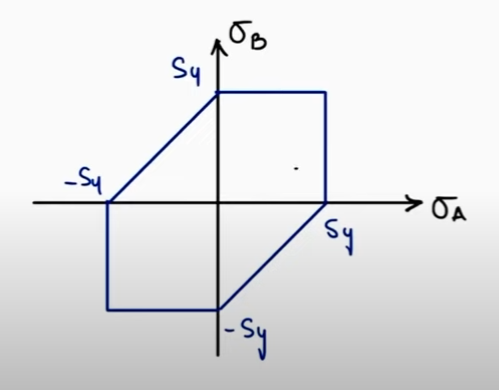
- Point inside the hexagon indicate that a material behaves elastically.
- Point on the boundary, begins and continues to yield.
- No stress points can lie outside the hexagon.
Maximum Distortion-Energy Theory
- The total elastic energy is divided into two parts: hydrostatic and deviatoric.
- Strain energy per unit volume > Yield Strain energy
- Hydrostatic: Associated with the volumetric changes of the material (1st Matrix).
- Deviatoric: Causing shear distortions (2nd Matrix). \(\begin{pmatrix} \sigma_{1} & 0 & 0\\ 0 & \sigma_{2} & 0\\ 0 & 0 & \sigma_{3} \end{pmatrix} = \begin{pmatrix} \bar{\sigma} & 0 & 0\\ 0 & \bar{\sigma} & 0\\ 0 & 0 & \bar{\sigma} \end{pmatrix} + \begin{pmatrix} \sigma_{1}-\bar{\sigma} & 0 & 0\\ 0 & \sigma_{2}-\bar{\sigma} & 0\\ 0 & 0 & \sigma_{3}-\bar{\sigma} \end{pmatrix}\)
- The total energy in terms of principal stresses is \(U_{0} = \frac{1}{2E}(\sigma_{1}^2 + \sigma_{2}^2 + \sigma_{3}^2) - \frac{\nu}{E}(\sigma_{1}\sigma_{2} + \sigma_{2}\sigma_{3} + \sigma_{3}\sigma_{1})\)
- The hydrostatic energy is given as \(U_{sph} = \frac{1-2\nu}{6E}(\sigma_{1} + \sigma_{2} + \sigma_{3})^2\)
- The deviatoric energy is given as \(U_{dev} = \frac{1}{12G}[(\sigma_{1}-\sigma_{2})^2 + (\sigma_{2}-\sigma_{3})^2 + (\sigma_{3}-\sigma_{1})^2]\)
- This gives the yield criterion as \(\sigma_{VM}^2 = (\sigma_{1}-\sigma_{2})^2 + (\sigma_{2}-\sigma_{3})^2 + (\sigma_{3}-\sigma_{1})^2 = 2 \sigma^2_{yp}\)
- This is also known as von Mises yield criteria and the stress is known as von Mises stress.
- The factor of safety $(n)$ is given as \(n = \frac{\sigma_{yp}}{\sigma_{VM}}\)
Linked from
- No other published notes link here yet.