Stress and Strain
Created on: 2025-01-30
Tags: #Stress #Strain
Course: MOS
Stress
- Forces acting on infinitesimal areas with varying magnitudes and cuts.
- They vary from point to point and are inclined with respect to the plane of the section.
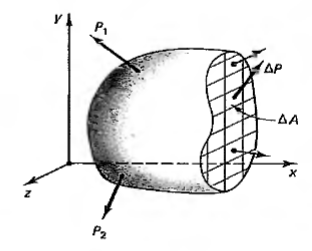
- For example the components of a force vector $\Delta P$ acting on an area $\Delta A$ is shown in the diagram.
-
The direction of $\Delta A$ is in the positive $x$ direction whereas the force $\Delta P$ can be resolved in the directions $x,y$ and $z$. \(\sigma_{xx} = \lim_{ \Delta A \to 0 } \frac{\Delta P_{x}}{\Delta A}\) \(\tau_{xy} = \lim_{ \Delta A \to 0 } \frac{\Delta P_{y}}{\Delta A}\) \(\tau_{xz} = \lim_{ \Delta A \to 0 } \frac{\Delta P_{z}}{\Delta A}\)
- The intensity of force perpendicular to the section is called normal stress at a point. They are designated by $\sigma$.
- The intensity of force acting parallel to the plane of the section are called shear stress. They are designated by $\tau$.
- The value of stress varies in different set of coordinate axes. The process of changing stresses from one set of coordinate axes to another is termed as stress transformation.
- The stress ($\sigma_{ij}$) is a second-rank tensor quantity i.e. one magnitude and two directions. \(\sigma_{ij} = \begin{pmatrix} \sigma_{xx} & \tau_{xy} & \tau_{xz} \\ \tau_{yx} & \sigma_{yy} & \tau_{yz} \\ \tau_{zx} & \tau_{zy} & \tau_{zz} \end{pmatrix}\)
- $\sigma_{ij} = \sigma_{ji}$ due to equilibrium conditions.
Stress Analysis of Axially loaded bars
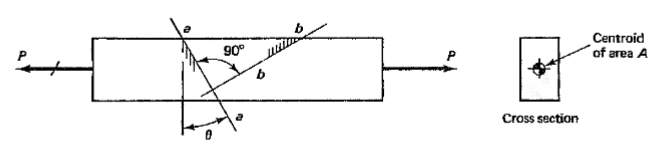
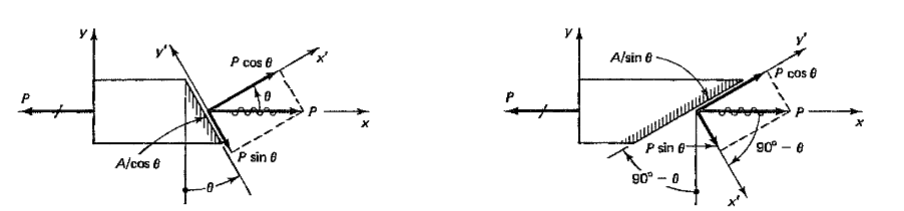
Stresses on the section $a-a$: \(\sigma_{\theta} = \frac{P}{A} \cos^2\theta\,\,\text{and}\,\, \tau_{\theta} = - \frac{P}{A}\cos \theta \sin \theta\) Stresses on the section $b-b$: \(\sigma_{\theta-90} = \frac{P}{A} \sin^2\theta\,\,\text{and}\,\, \tau_{\theta-90} = \frac{P}{A}\cos \theta \sin \theta\) Now, the normal and shear stress vary with $\theta$ and the maximum normal stress is achieved at $\theta=0$, where \(\sigma_{max}=\frac{P}{A} = \sigma_{x}\) The maximum shear stress is obtained at $\theta=\pm 45^{\circ}$ \(\tau_{max} = \frac{P}{2A} = \frac{\sigma_{x}}{2}\)
Analysis of Stresses
- The deformation in engineering structures are negligible as compared to their dimension, hence the original undeformed dimension of members are used in computations.
-
The governing equations/conditions for equilibrium of a structure are \(\begin{gathered} \sum F_{x} = 0\\ \sum F_{y} = 0\\ \sum F_{z} = 0\\ \sum M_{x} = 0\\ \sum M_{y} = 0\\ \sum M_{z} = 0 \end{gathered}\)
- If the equations of statics suffice for determining the external reactions as well as the internal statics stress resultants, a structural system is statically determinant.
- Otherwise, it is statically indeterminant.
Strain
- Normal Strain: Strain associated with normal stress. Also known as engineering strain. \(\varepsilon = \frac{L-L_{0}}{L_{0}} = \frac{\Delta L}{L_{0}}\)
- True Strain: The strain increment $d\varepsilon$ is defined as $dL/L$, where L is the instantaneous length of the specimen. \(\bar{\varepsilon} = \int_{L_{0}}^L \frac{dL}{L} = \ln\left( \frac{L}{L_{0}} \right) = \ln(1+\varepsilon)\)
- For small strains, the value of engineering strain and true strain agree but for applications with large strain, they differ.
- They are measured using strain gauges.
- Engineering Stress: Stress calculated using the original area of a specimen.
- True Stress: Stress calculated using the instantaneous area of the specimen.
Linked from
- No other published notes link here yet.