Double-base
Double-base Propellants
Created on: 2024-11-28
Tags: #doublebasePropellants
Course: Rocket Propulsion
Definition
Comprises of Nitrocellulose (NC) and nitroglycerine (NG) mixed together at the molecular level to form a homogenous propellant grain
- Both NC and NG have fuel and oxidizer in them and can be used singly as propellant - single base propellant.
- NC and NG used together constitute double base propellant.
Mechanism of Burning
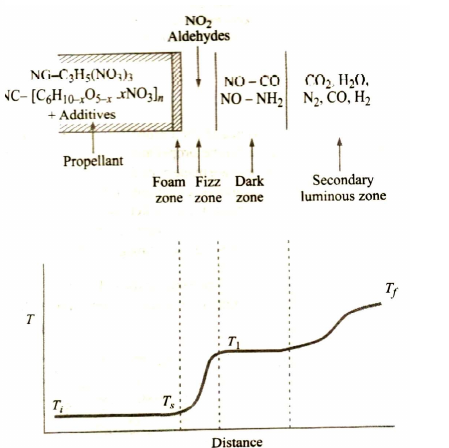
Burn rate evaluation
General expression for burn rate in a double-base propellant is given as
\[r = ap^n\]Where,
- a: Temperature coefficient, depends on the initial temperature, composition and other characteristics of the propellant.
- p: pressure
- n: pressure exponent/combustion index.
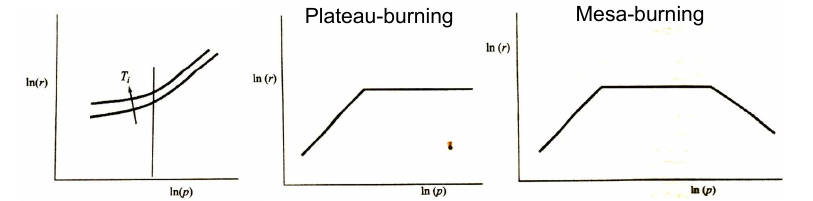
Influence of initial temperature on burn rate
\[\Pi_{r} = \frac{1}{r} \frac{dr}{dT}|_{p}\]Fractional variation in r due to unit temperature change at constant pressure.
\[r = r_{T_{0}}e^{\Pi_{r}(T-T_{0})}\]$T_{0}$ is the reference temperature and $r_{T_{0}}$ is the burn rate at that temperature.
By convention the chamber pressure is non-dimensionalized with reference to 7 MPa
\(r = r_{7MPa}\left(\frac{P}{7}\right)^n\) Where $P$ is in MPa.
Choice of index n for stable operation.
Operating point is stable if the pressure and mass flow rate are stable in time.
\(P_{eq} = \left(aC^* (\rho_{p} - \rho_{g}) \frac{S_{b}}{A_{t}}\right)^\frac{1}{1-n}\) Where,
- $P_{eq}$ is the equilibrium pressure.
- $C^*$ is the Characteristic Velocity.
- $\rho_{p}, \rho_{g}$ are the density of propellant and gas.
For stable operation, $n<1$ or $n <\frac{1}{1 - \frac{\rho_{g}}{\rho_{p}}}$
Factors effecting Burn Rate
- Variation of burn rate with size of rocket:
- Variation in size of rocket changes the radiation and convection rate.
- Thus, variation in burn rate even for same pressure.
- Erosive burning with long propellant grains
- Increase in propellant burning rate due to high velocity of the combustion gases flowing parallel to the burning surface.
- Leads to shear force and heat transfer.
- Burn rate enhancement with acceleration
- Accelerates the flame towards burning surface by centrifugal forces.