Injector
Created on: 2024-11-28
Tags: #injector
Course: Rocket Propulsion
Definition
*Injector has the following functions, *
- Introduce and meter the flow of liquid propellants into the combustion chamber.
- Atomization
- Improve mixing of fuel and oxidizer
- Types:
- Pressure atomizing
- Gas-assist injectors
Atomization
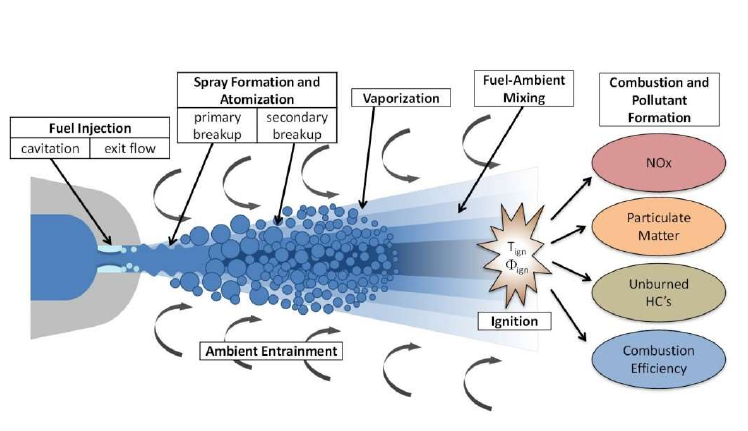
Pressure Atomizing Injectors
Liquid fuel and oxidizer are supplied at high pressure to the injector to form high velocity liquid jets.
Showerhead Injector
- A series of slender parallel jets of liquid fuel and oxidizer are formed from a number of holes provided in an injector.
- Poor mixing
- Not very efficient atomization.
Impinging Jet Injectors
- High velocity jets are made to impinge on each other and form liquid sheets, which then break up into fine droplets.
- Multiple configurations
- Doublets
- Triplets
- Quadruplets
Doublets
- Jet A and Jet B impinge with each other and form a fan perpendicular to the plane.
- Orientation of fan depends on the impingement angle of jets and their respective momentum.
- Impinging Jet Like Propellant: Jet A and Jet B exhaust either propellant or oxidizer.
- Impinging Jet Unlike Propellant: Jet A and Jet B exhaust exhaust fuel and oxidizer respectively.
Coaxial Injectors
- Annular liquid spray fans are formed by injecting the liquid fuel and liquid oxidizer coaxially.
- Sheets formed are coaxial and can be impinging/non-impinging.
Gas-assist injectors
- Uses high velocity gaseous medium to atomize the liquid fuels or oxidizers.
- Aerodynamic shear arising from the gas flow over the liquid causes the droplets to be formed.
Factors influencing injector behavior
- Propellant combination: A design generally doesn’t work for all propellant combinations.
- Orifice pattern and Orifice Size: Performance is dependent on orifice size, angle of impingement, number of orifices, distribution of orifices, etc.
- Transient Conditions
- Hydraulic Characteristics: Injection velocity depends on the orifice type and pressure drop across the orifice.
- Heat Transfer
- Structural Design
- Combustion Stability