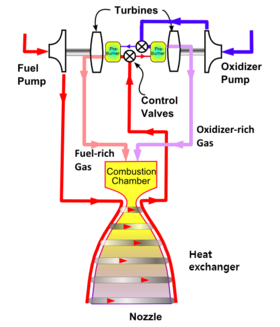
Propellant Feed System
Created on: 2024-11-28
Tags: #propellantFeedSystem
Course: Rocket Propulsion
Definition
The functions of the propellant feed systems are given as follows,
- To raise the pressure of the propellants.
- To feed the propellants at predicted mass flow rates to one or more thrust chambers.
Types:
- Gas pressure feed system
- Gives superior performance when total impulse/mass of propellant is low.
- Turbopump feed system
- Superior performance when total impulse/chamber pressure is large.
Gas pressure feed system
- Propellants forced out of their respective tanks by displacing them with high pressure gas.
- Types:
- Regulated: uses a gas pressure regulator in the gas feed line and the engine operates as constant tank pressure and nearly constant thrust.
- Blow-down: The gas or vapour column above the liquid surface is directly pressurized.
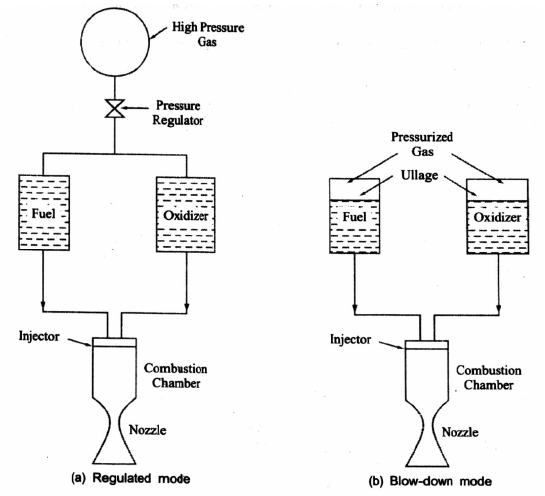
| Criteria | Regulated | Blow-Down |
|---|---|---|
| Pressure/Thrust | Constant | Decreases as propellants is consumed |
| Gas Storage | High-Pr tanks | Stored inside propellant tank with large ullage volume |
| Components | Regulator, filter, gas valves and tank | Larger, heavier propellant tanks |
| Advantages | Constant F, $I_{sp}$ | Simple system, less gas required |
| Disadvantages | More complex, pressure drop at regulators | Less accurate mixture control. $I_{sp}$ decreases with time. |
Turbopump feed system
- Pumps used for supplying propellants from the tanks into the combustion chamber.
- Enormous power requirements.
- Pumps are usually driven by turbines which derive power from expansion of warm gases.
Engine Cycles: It describes the specific propellant flow path through the major engine components.
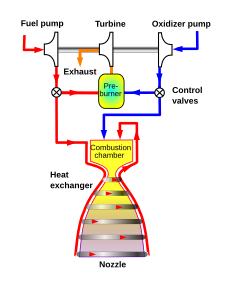
- Gas Generator:
- Open Cycle
- Some fuel and oxidizer is used to run the turbine and some used for combustion after cooling the nozzle.
- Pre-burner is used to heat the fuel and oxidizer before sending to turbine.
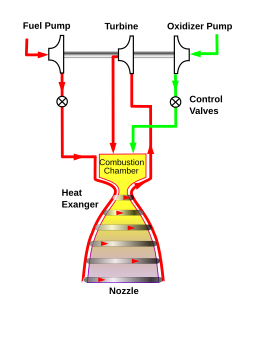
- Expander:
- Closed Cycle.
- All fuel used for cooling of nozzle, to operate turbine and then passed to CC.
- Staged:
- Closed Cycle.
- Combination of Gas Generator and Expander.
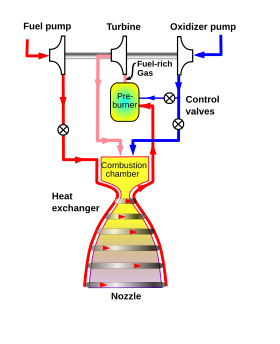
- Full Stage Combustion Cycle:
- Full flow of both propellants through the turbines.
- Separate turbine used for fuel and oxidizer.
- Full gasification of each propellant before entering the combustion chamber.
- Turbine runs cooler and at lower pressure.
- Increased engineering complexities due to two preburners and two turbines.