Trajectory
Trajectory and Orbital Period
Created on: 2025-01-03
Tags: #Trajectory #OrbitalPeriod
Course: Space Dynamics
Orbit Equation
\(r = \frac{h^2}{\mu} \frac{1}{1+e\cos \theta}\) 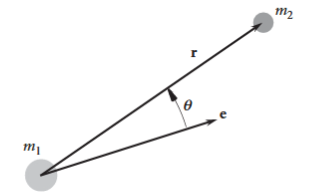
For a given orbit $h,\mu,e$ are constants where as the position of
\(\mathbf{h} \cdot \mathbf{e} = 0\) The angular momentum vector is always perpendicular to the eccentricity vector.
We know the component of velocity tangent to the orbit $(v_{\perp})$ is given as \(v_{\perp} = r \dot{\theta}\) Whereas $h=r^2\dot{\theta}$, then $v_{\perp} = \frac{h}{r}$. Therefore, \(v_{\perp} = \frac{\mu}{h} (1+e\cos \theta)\) Since, $v_{r} = \dot{r}$, we have \(v_{r} = \frac{\mu}{h} e\sin \theta\)
The flight path angle $\gamma$ is given as \(\tan \gamma = \frac{v_{r}}{v_{\perp}}\)
The total mechanical energy per unit mass $\varepsilon$ is given as \(\frac{v^2}{2} - \frac{\mu}{r} = \varepsilon = -\frac{1}{2} \frac{\mu^2}{h^2}(1-e^2)\)
Circular Orbit ($e=0$)
- Constant $r$
- Constant time-period $T$
- $v=v_{\perp}$
\(r = \frac{h^2}{\mu}\) \(T = \frac{2\pi h}{\mu} = \frac{2\pi}{\sqrt{\mu}} r^{1.5}\) \(\varepsilon = -\frac{1}{2} \frac{\mu^2}{h^2}\)
Elliptical Orbit ($0<e<1$)
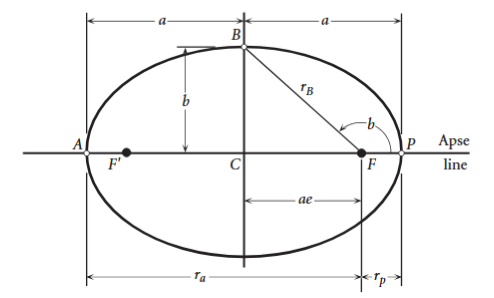
- Peri –> Close, $\theta=0$, $r_{p}$
- Apo –> Away, $\theta=180$, $r_{a}$
- $2a = r_{a}+r_{p}$
- $b = a\sqrt{1-e^2}$
- $T = \frac{2\pi}{\sqrt{ \mu }}a^{1.5}$
- $\frac{r_{p}}{r_{a}} = \frac{1-e}{1+e}$
- $e = \frac{\text{distance between the foci}}{\text{length of the major axis}}$
Parabolic Orbit ($e=1$)
- $\varepsilon$ = 0
- $v = \sqrt{\frac{2\mu}{r}}$
- As $\theta \rightarrow 180^{\circ}$, $r \rightarrow \infty$ and $v \rightarrow {0}$
- Parabolic paths are known as escape trajectories, since the mass escapes from the influence of gravity of the host and never returns.
- Hence, the escape velocity for the trajectory is given as \(v_{esc} = \sqrt{\frac{2\mu}{r}} = \sqrt{2}v_{o}\) Where $v_{o}$ is the speed of a satellite in a circular orbit of radius $r$.
Hyperbolic trajectories ($e>1$)
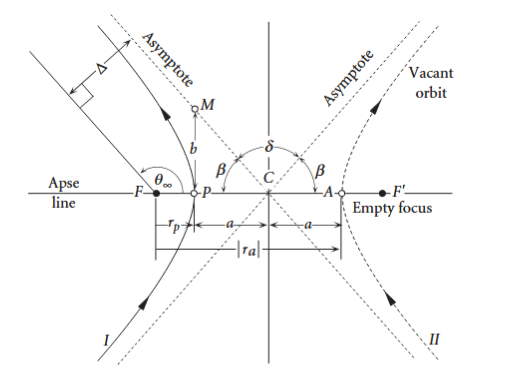
- The system consists of two symmetric curves.
- One of them is occupied by the orbiting body while the one is its empty, mathematical image.
- $r \rightarrow \infty$ for $\theta = \cos^{-1}(-1/e)$
- Periapsis lies on the apse line on the physical hyperbola.
- Apoapsis lies on the apse line on the vacant hyperbola.
- The asymptotes of the hyperbola intersect at C which is the center of the hyperbola. They make an acute angle with the apse line, where $\beta=180^{\circ}-\theta_{\infty}$
- The angle $\delta$ between the asymptotes is called the turn angle. \(\delta = 2 \sin^{-1}(\frac{1}{e})\)
- $\Delta=b=a\sqrt{ e^2 -1 }$
Linked from
- No other published notes link here yet.