Code Overview
High-level source code overview
Created on: 2024-12-26
Tags: #SourceCodeOverview
Course: SU2
Governing Equations
Navier-Stokes Equations
Governing equation form of Navier-Stokes for steady flow problem. 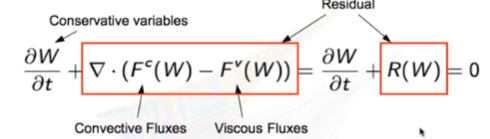
At each iteration the solver will
- Compute $R(W)$
- Compute an update to $W$ to drive $R(W) \rightarrow 0$
Primal v/s Dual Grids
The initial grid made in any meshing software is known as the Primal Grid, whereas the grid computed by SU2 as finite volumes is known as Dual Grid.
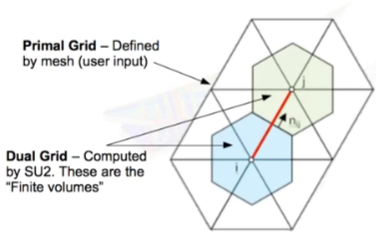
Face: The face of finite volume where the integrals are computed.
Finite Volume Method
The GDE is integrated over a finite volume $\Omega_{i}$ \(\int_{\Omega_{i}}\frac{\partial W}{\partial t}\, d\Omega + \int_{\Omega_{i}} \nabla (F^c(W) - F^v(W))\, d\Omega = 0\) Using Green-Gauss theorem to convert to boundary integral, which is equal to the the $R(W)$.
Computing convective flux
- Solution data stored at points $i$ and $j$
- Flux needed at face
- Desirable properties for a scheme to compute the flux
- Stable
- Upwinding
- Capture shocks
- Low dissipation in smooth regions
- High-order accuracy
- SU2 implements
- JST
- Roe
- HLLC
- AUSM
Computing viscous fluxes
- How to compute gradients ?
- Green-Gauss
- Weighted Least Square
- This gives gradients at each point $i$ and $j$.
- For gradients at the face
- Use finite difference to compute the gradients parallel to $ij$
- Use Corrected Average Gradient
Time-stepping
- Explicit: $W$ computed at current time step
- Implicit: $W$ computed at the next time step \(\frac{|\Omega^n_{i}|}{\Delta t_{i}^n} \Delta W_{i}^n = -R_{i}(W^{n+1})\) Solved using Taylor-series approximation.
- Solution strategies:
- FGMRES
- Bi-CGSTAB
- Acceleration via Preconditioners
Linked from
- No other published notes link here yet.