Residuals
Created on: 2025-02-28
Tags: #Residuals
Course: SU2
Definition
- Each PDE is broken down into $AX=B$.
- Each row in this matrix represents the conservation equation for each cell.
- For an non-converged solution, there is an imbalance in the conservation equation. This is handled by addition of an extra term known as residual. \(AX + B = r\)
- To calculate the residual for a current iteration, we use the solution for the current iteration into the above equation.
- The closer $r$ is to zero, the more accurate the current solution.
\(A_{p}T_{p} - \sum_{Cell} a_{nb}T_{ab} - B_{p} = r_{p}\)
Assessing Convergence
- The residual vector will never become exactly zero.
- However, if the residual vector is sufficiently small, then we can stop the calculation and use the solution for post-processing.
- The residual vector is a scalar field which can be visualized through a contour plot but it is not practical to access the contour plot for every iteration.
Representative Residual
- It is useful to have a single value that is representative of the residual in all the cells.
- A single value is easier to track every iteration with a line plot.
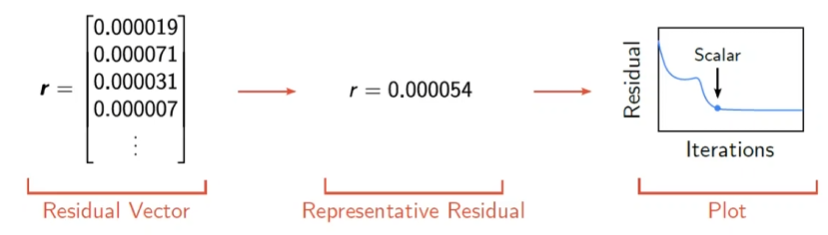
- The representative residual is calculated differently by different CFD codes.
- All of the definitions are based on the one of the following norms
- $L_{1}$ norm - Provides equal weighting to all components.
- $L_{2}$ norm - RMS
- $L_{\infty}$ norm - The maximum absolute value.
- To remove this dependency on the length of the vector N. redefine the different definitions of the representative residual: \(r = \frac{||r||_{2}}{N^{0.5}}\)
Scaling
- The scaled residual is defined as the percentage of quantity lost/gained in the cell. \(r_{s} = \frac{r}{n}\)
- $n$ is the scaling factor.
- We can calculate the scaling factor in two ways:
- Manual calculate the scaling factor. This is cumbersome and is not possible for all problems.
- General Scaling Factor: The scaling factor is calculated using the product of diagonal elements of the $A$ matrix and a representative $\Delta T$
- The temperature difference is not explicitly expressed how it is being calculated.
- The reduction in the order of magnitude of the scaled residual is used to assess the convergence, not the exact value.
Normalization
- There is no matrix equation for continuity equation, hence it is treated same as the other transport/conservation equations.
- Rather than scaling the mass imbalance, the mass imbalance is normalized instead.
- We divide the mass imbalance by the maximum value to normalize it and understand the orders of reduction. \(r_{norm} = \frac{r}{max(r)}\)
- Scaling and normalizing lead to quite different values.
- It is common to use the maximum value from the first 5 iterations for normalization. \(r_{norm} = \frac{r}{max_{\text{ 5 Iterations}}(r)}\)
- If the solution diverges, then the maximum mass imbalance keeps increasing.
- This is why the maximum value for normalization is often taken over the first five iterations.
Linked from
- No other published notes link here yet.