SA Model
Spalart-Allmaras Model
Created on: 2024-12-30
Tags: #SAModel #TurbulenceModelling
Course: SU2
History
- The turbulent/eddy viscosity is computed using RANS turbulence models.
- $k-\epsilon$ model is not accurate at predicting boundary layers with adverse pressure gradients.
- A better model is required for aerodynamics and turbomachinery.
Spalart-Allmaras Model
Behavior of turbulent viscosity near the wall for a flat plate ?
- In the logarithmic region ($y^+ >30$), the variation of $\nu_{t}$ is linear. \(\frac{\nu_{t}}{\nu} = \kappa y^+\)
- Near the wall in the viscous sub-layer, the profile varies with $(y^+)^4$
- A lot of cells close to the wall is required as flow quantities is varied linearly.
Spalart-Allmaras Variable
- A new variable $\tilde{\nu}$ is solved instead of $\nu_{t}$. It is similar to $\nu_{t}$.
- It is straight line everywhere for a flat plate boundary layer with no pressure gradient.
- It is easier to solve numerically.
- A transport equation for $\tilde{\nu}$.
- Once, we have solved for $\tilde{\nu}$, we can calculate for $\nu_{t}$ \(\nu_{t} = \tilde{\nu}f_{v1},\,\,\,\, f_{v1} = \frac{X^3}{X^3 + c^3_{v1}}, \,\,\,\, X=\frac{\tilde{\nu}}{\nu}\)
- This function $f_{v1}$ captures much of the viscous damping effects.
SA Transport Equation
The transport equation for $\tilde{\nu}$ is given as 
- LHS is the temporal derivative and convective term.
Turbulence Generation
- Represented by the first term of RHS.
- Turbulence is produced by shear. $S$ is the shear rate tensor.
- It is a positive term. \(\mathbf{S} = 0.5(\nabla \mathbf{U} + (\nabla \mathbf{U})^T),\,\,\, S= \sqrt{ \mathbf{S}:\mathbf{S}}\)
Diffusion of Turbulence
- Most transport equations contain a diffusion term of the form $\nabla \cdot (\Gamma \nabla \phi)$
- 2nd term of RHS.
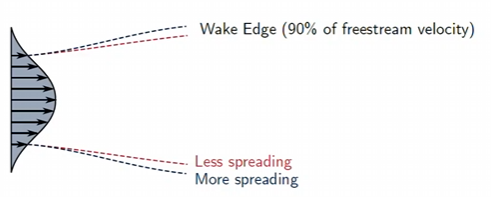
- The diffusion term also has an additional non-linear term ($c_{b_{2}}(\nabla \tilde{\nu})^2$).
- The value of $c_{b2}$ was calibrated to 0.622 to get a more accurate spreading of the wake profile.
- The non-linear term is often referred as source term.
Destruction of Turbulence
- Last term of RHS.
- Presence of wall destroys turbulence through viscosity and inviscid blocking.
- $d$ is the distance to the nearest wall.
- $f_{w} \rightarrow 0$ as $d \rightarrow 0$ to prevent a divide by zero error.
Boundary Conditions
- $\tilde{\nu}=0$ at the wall.
- In the freestream, $\tilde{\nu} = \nu_{t}$. \(\tilde{\nu} = \nu_{t} = \frac{C_{\mu}k^2}{\epsilon}\,\,or\,\, \tilde{\nu} = \nu_{t} =\frac{k}{\omega}\)
- $k$ and $\omega$ can be calculated from a length-scale (10% of the aerofoil chord length) and turbulent intensity (5%). \(k = \frac{3}{2}U^2 I^2\,\,\, \epsilon = \frac{C_{\mu}k^{1.5}}{l}\)